
Introduction
As a development-focused professional, my experience around deployment has focused on supporting subject experts and teaching staff to design materials, creating pedagogically sound learning objectives, along with material and assessment that allows students to meet them. This is part of the end-to-end project management and delivery role of a developer. I have also been involved in administering organisational systems like Moodle, and managing or supporting transitions, such as re-theming, moving platforms and departmental change in digital learning teams.
Deployment of grading system


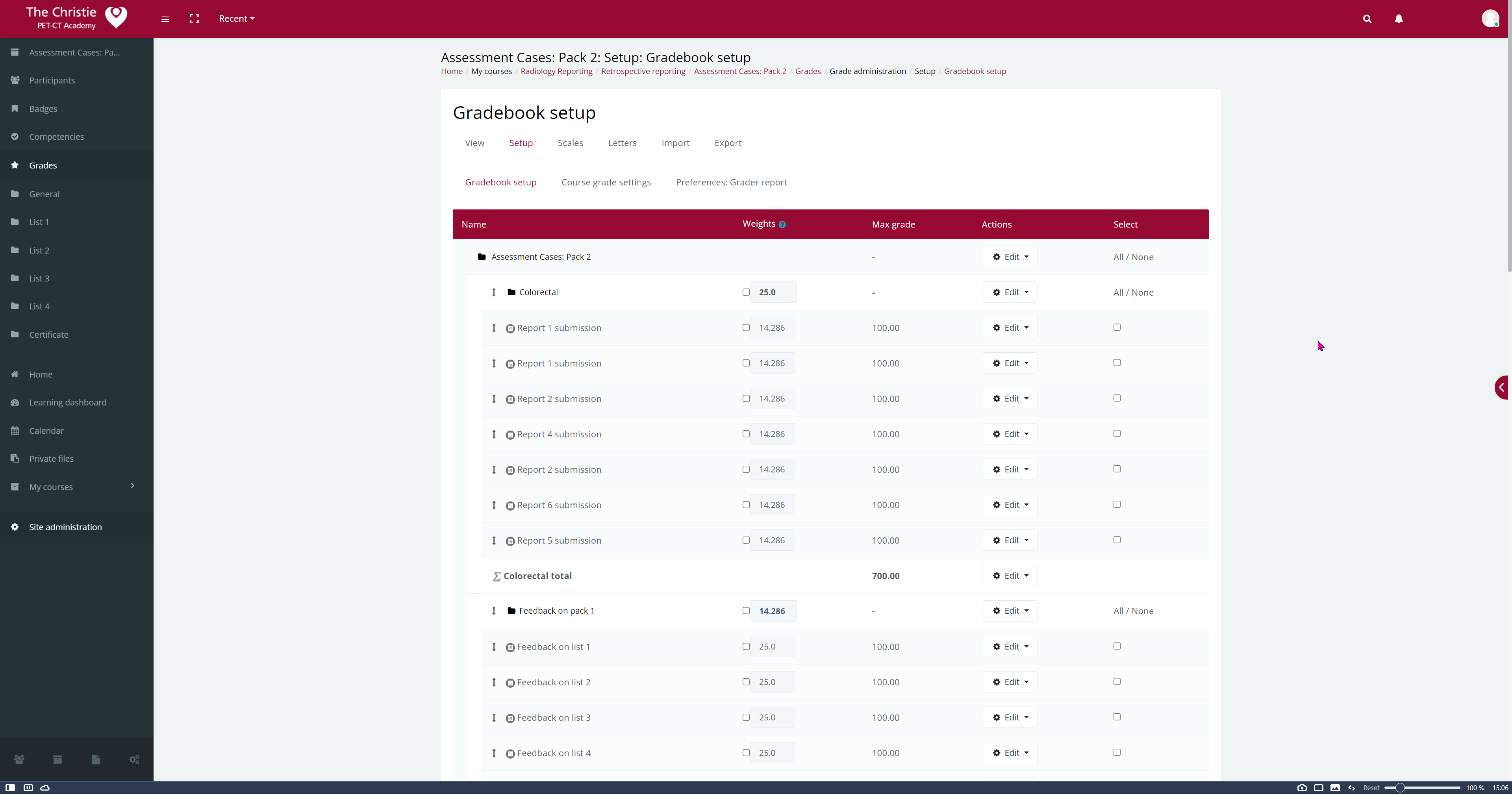

One of the main projects I worked on at the Christie Hospital was the national PET/CT training contract, and in particular training for radiologists. One of the challenges we faced was in developing a robust grading system to enable us to accredit radiologists to report PET/CT scans. The solution I developed used inbuilt Moodle features, so did not require any additional expenditure on plug-ins or other systems.
Radiologists typically complete proformas when reporting scans, so a form seemed like a good solution. I was able to develop a standard form using Adobe Acrobat DC, with free text fields that would resize text once the physical limitation of the text box was breached. This is important, because during testing, I discovered that Moodle did not work with scrollbars in text fields on a PDF document. This meant that the text could become quite small, so could have been hard for a grader to read — as a workaround, if this was a problem the original PDF can be downloaded by the grader outside the grading interface and viewed separately.
An assessment course was set up to provide access to the proformas and assignment submission activities for each case. Learners have to submit many cases for assessment, provided in packs of six cases. The course page also provides instructions on how to submit completed report forms. An instructional video was added when it came to light that forms completed inside a web browser do not retain the text written. It’s therefore important that learners know that they must download the form and open it in the Adobe Reader application in order to make changes to the file that will be saved appropriately. Once learners have the proforma, they look at the reference number provided on it and look up the scan images on their reporting station to allow them to complete it.
The other half of this is the grading criteria. Moodle has provision for marking guides; suitable guides were written in conjunction with radiology staff, with a different guide per disease type. These could then be customised for each specific case. This was necessary, because not every case has exactly the same features to grade and without customising the grading scheme, learners would have points deducted for features that were not identified or commented upon, but that were also not relevant for the case.
Graders use the standard Moodle grading system, which displays the submitted file on the left of the screen and provides the grading scheme to the right with space for marks to be allocated, alongside comments.
This solution works well, and has now been in operation for several years. It has been instrumental in allowing the programme to track and accredit the development of radiologists registered on the course, supporting new reporters into the workforce and helping to ease a substantial shortfall in the number of reporters in PET/CT nationally.
I developed a Rise resource for Learning Technologists, which included training on how to add additional assessment courses and cases, and how to set up the grading system. The relevant excerpt can be seen on Articulate Review via the link above.
Supporting change and team development
The Covid-19 pandemic has led to a significant amount of transformation in the way that many of us do business, learn and teach. This occurred over a very short amount of time, almost overnight for many people. We now reach the point where we need to consolidate the lessons learned from this abrupt change, move away from emergency thinking and towards embedding good digital learning practices in a potentially more receptive environment.
As part of this challenge, Durham University has invested significantly more resource into digital learning development from 2022 onwards. We are in the process of recruiting an additional 18 posts, to embed digital development at the faculty level. These posts will transform the ability of faculties to produce high quality digital learning material; at present, omly the business school has a dedicated development resource, and there are two pan-university digital learning developers (including myself) within DCAD.
During this expansion, I have been involved in specifying standard hardware and software requirements for new developers (my recommendations can be downloaded from the link below), and have also had some input into the job descriptions. One of the new posts advertised was for a G8 Senior Digital Learning Developer within DCAD, which I applied for and have been appointed to. Since I have been involved in the team since it started in 2020, I have also co-designed our local policies and practices alongside my colleagues. This includes our project management tools (see image to the right) and pipeline, and our quality standards.

As an Established Digital Learning Developer at Durham, Nic’s input in developing our recruitment of Digital Learning Developers has been essential. She has provided key input into developing a paper to the Institutional Learning and Teaching Group to provide key hardware and software requirements for the role and has had input to the job description. This input has led to the successful appointment of new staff critical to delivering DU’s digital vision.
Professor Sam Nolan, Depute Director for Academic Excellence, Durham Centre for Academic Development
One of the challenges associated with this new expansion will be to foster a level of community and inclusion amongst the new, distributed developers and to maintain a high level of consistent quality across the university’s development output. Part of my role therefore, will be to scaffold development opportunities, social spaces and practice sharing opportunities to encourage a cohesive and cooperative working environment.
My previous experience in this area stems from work at the Christie NHS Foundation Trust. Whilst working at the Trust, I was in a leadership and management role, managing at first a small team, and then as part of a temporary interim management post, leading the whole digital learning team. During this short time, I was able to improve the morale and team cohesion by bringing in regular team meetings, practice sharing events and introducing new project management systems to help organise our work. My staff at the time remarked on the impact that these changes had on the sense of being part of something greater, feeling that there was an improved motivation and sense of belonging among the team.
Nicola has a high degree of skill and expertise in the shaping and design of effective learning. She has demonstrated exceptional knowledge of education and is able to apply that knowledge to learning that is engaging and informative. Nicola has proved to be a leader who is able to motivate and inspire her team.
Owen Seago, Senior Learning Technologist, The Christie NHS Foundation Trust